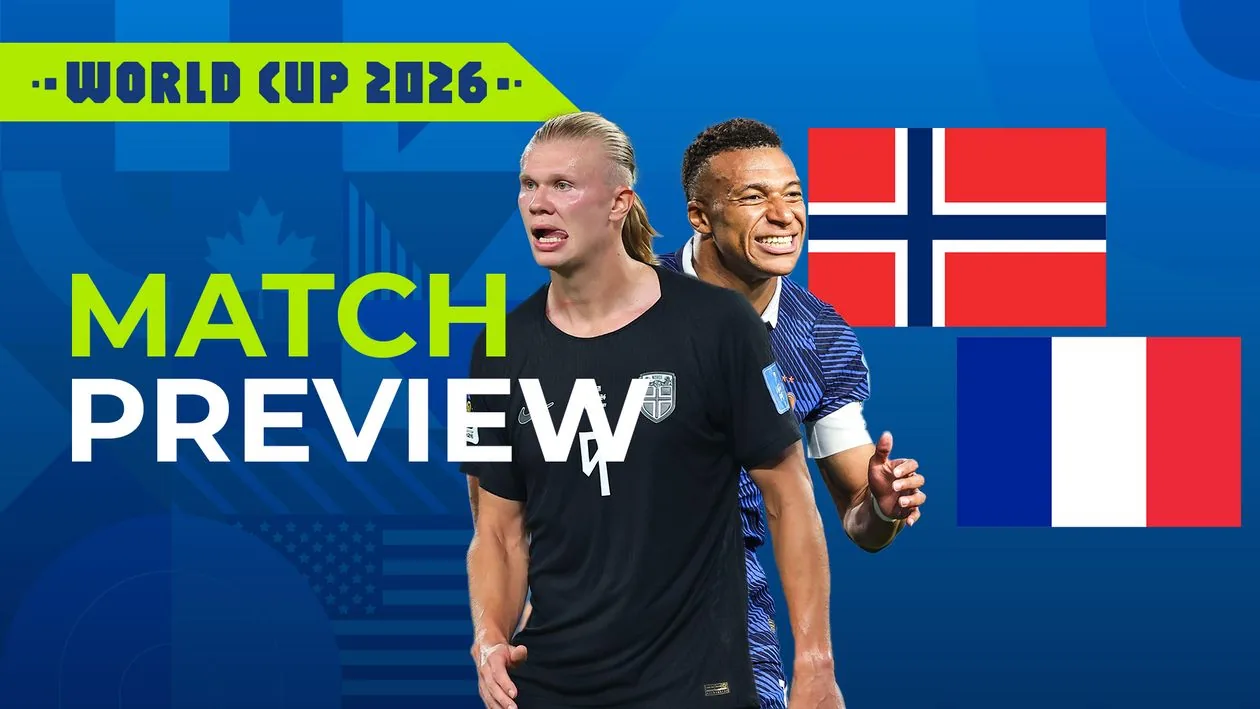
Norway opted to make significant changes to their starting lineup for their World Cup 2026 group stage match against France, with manager Stale Solbakken making 10 alterations. This decision included resting prominent players like Erling Haaland and Martin Odegaard, despite the fixture being billed as a potential Golden Boot contest between Haaland and France’s Kylian Mbappe. France ultimately secured a 4-1 victory.
The match, which took place in Foxborough, saw Ousmane Dembele score a 25-minute first-half hat-trick for France. Desire Doue added a fourth goal for Les Bleus. Norway‘s only goal came from Thelo Aasgard, while Jorgen Strand Larsen missed a penalty for the Norwegian side.
Managerial decisions and their implications
Solbakken defended his decision to rest players, describing it as a “no-brainer” due to the short turnaround between games. He stated that the health and medical departments, along with some players, were in agreement. The manager noted that five or six players were significantly affected after 80 minutes in their previous game against Senegal, including the entire defensive line and one or two midfielders.
The only consideration against the changes, according to Solbakken, was for the Norway fans who would have wanted to see Erling Haaland and Martin Odegaard play. Former England striker Ian Wright commented before the game that if Haaland needed rest for later stages of the tournament, he would take it. Haaland himself had previously expressed his thoughts on facing France, suggesting they would likely win against Norway and potentially the entire tournament.
Norway had already qualified for the knockout stages, having won their previous two group games against Iraq and Senegal. France also secured their spot in the next round by winning all three of their group matches. Assistant coach Guy Stephan, deputising for Didier Deschamps, who was absent, indicated that he was not surprised by Norway‘s changes, understanding that Solbakken was preparing for the round of 32.
Travel and tournament path
The outcome of the match means France topped Group I, setting up a last-32 encounter at the New York New Jersey Stadium on 30 June against the runners-up of Group F or G. Norway, as group runners-up, now face a substantial 1,100-mile journey for their next game. They will travel from Greensboro, North Carolina, to Arlington, Texas, to play Ivory Coast on the same day.
Had Norway topped the group, their travel distance would have been significantly shorter. If Norway defeats Ivory Coast, they would then proceed to New Jersey for a last-16 tie on 5 July against the winners of the Brazil–Japan match.
Former Scotland winger Pat Nevin highlighted the complexities of the travel distances involved. He suggested that ensuring players are fit might have been a primary concern for Norway‘s management. Nevin also noted the physical style of play adopted by Norway, suggesting that avoiding injuries to key players was a priority.
Roy Keane, a former Republic of Ireland midfielder, acknowledged the reasoning behind Norway‘s strategy, pointing out that the team is not as accustomed to tournament football as France. He suggested that Norway‘s priority was to advance from the group, which they achieved, and that the manager likely aimed to rest players for the next stage rather than risk them against France.
Norway is participating in their first World Cup since 1998.
Historical precedent and fan reactions
The decision to make numerous changes in a final group stage match has historical precedents in the World Cup. In 2006, Spain made 11 changes against Saudi Arabia and won, but later lost to France in the last 16. Conversely, in 2018, Belgium made 10 changes, defeated Japan 3-2, and then beat Brazil 2-1 in the quarter-finals before being eliminated by France.
Thousands of Norway fans travelled to the United States to support their team. While some expressed surprise at the team news inside the stadium, others continued their Viking-style row celebration throughout the game, indicating a determination not to let the decision affect their enjoyment.
France‘s depth was evident in the match, with players like Michael Olise, Bradley Barcola, and Desire Doue contributing to their attacking prowess. Dembele‘s hat-trick showcased the team’s ability to perform with various attacking options. France had previously rotated players in their 3-0 win over Iraq, with Lucas Digne, Manu Kone, and Bradley Barcola replacing other starters.
The match concluded with France topping Group I, securing their path to the next round, while Norway prepares for their challenging travel schedule and knockout stage fixture against Ivory Coast on 30 June.
Read Also
- England prepare for Panama challenge in New York/New Jersey after Ghana draw
- USA coach Mauricio Pochettino unconcerned by Turkey defeat ahead of knockout stage
- Senegal awaits World Cup knockout fate after strong win against Iraq
- Nottingham: Duckett century and Stokes bowling lead England recovery against New Zealand
Source: bbc.co.uk